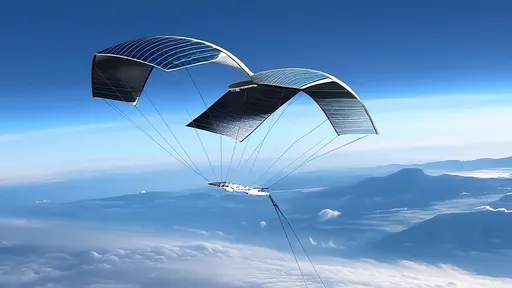
The quest for renewable energy has taken a bold leap into the skies, quite literally, with the emergence of high-altitude wind power systems. Among the most intriguing innovations in this space is the concept of tethered airborne wind energy (AWE) systems, colloquially known as "wind kites." These devices aim to harness the powerful and consistent winds found in the stratosphere, a layer of the atmosphere that has remained largely untapped by traditional wind turbines. Unlike conventional wind farms, which are limited by land use and lower-altitude wind variability, stratospheric wind kites promise a revolutionary approach to generating clean energy.
The principle behind high-altitude wind kites is deceptively simple. By using lightweight, aerodynamic wings or turbines tethered to the ground, these systems can reach altitudes where winds are stronger and more persistent. The energy generated is transmitted to the ground via the tether, which also serves as a conduit for control signals. This eliminates the need for massive towers and foundations, reducing both material costs and environmental impact. The potential energy yield is staggering—studies suggest that stratospheric winds could provide up to 100 times the global energy demand if efficiently captured.
One of the most compelling advantages of stratospheric wind kites is their ability to operate in regions where traditional wind or solar power may be impractical. Remote areas, offshore locations, and even disaster-stricken zones could benefit from rapidly deployable AWE systems. Unlike solar panels, which are dependent on daylight, or ground-based wind turbines, which require specific wind conditions, high-altitude kites can generate power almost continuously. This reliability could make them a cornerstone of future energy grids, complementing other renewable sources to ensure a stable supply.
However, the technology is not without its challenges. Engineering a system that can withstand the extreme conditions of the stratosphere—including freezing temperatures, intense UV radiation, and sudden wind shifts—requires cutting-edge materials and design. The tether itself must be incredibly strong yet lightweight, capable of transmitting electricity without significant losses. Additionally, airspace regulations and safety concerns pose significant hurdles, as the devices must avoid interference with aircraft and other airborne systems. Researchers and startups in this field are racing to address these issues, with several prototypes already undergoing rigorous testing.
Despite these obstacles, the progress in high-altitude wind energy has been remarkable. Companies like Google's Makani (though now defunct) and others such as Kitekraft and SkySails have demonstrated the feasibility of airborne wind energy, albeit at lower altitudes. The lessons learned from these ventures are now being applied to stratospheric projects, with some experts predicting commercial viability within the next decade. Governments and investors are beginning to take notice, funneling millions into research and development to accelerate the technology's maturation.
Environmental considerations also play a crucial role in the adoption of stratospheric wind kites. While the carbon footprint of manufacturing and deploying these systems is not negligible, it pales in comparison to the lifetime emissions of fossil fuel plants. Moreover, the visual and noise pollution associated with traditional wind turbines is virtually absent with high-altitude systems, making them more palatable to communities concerned about landscape disruption. Wildlife impact, another contentious issue with conventional wind farms, is also minimized, as the kites operate far above bird migration paths.
The economic implications of widespread AWE adoption are equally promising. By decentralizing energy production, high-altitude wind kites could reduce reliance on large-scale power plants and long-distance transmission lines, which are vulnerable to outages and inefficiencies. This could democratize energy access, particularly in developing nations where grid infrastructure is lacking. Furthermore, the modular nature of these systems allows for scalable deployment, enabling communities to start small and expand as needed.
Looking ahead, the integration of stratospheric wind energy into global power grids will require not just technological innovation but also policy adaptation. International collaboration will be essential to establish standards for airspace use, safety protocols, and energy distribution. As with any disruptive technology, public perception and acceptance will shape its trajectory. Educating stakeholders about the benefits and addressing concerns transparently will be key to overcoming resistance.
In the grand scheme of renewable energy, high-altitude wind kites represent a bold and imaginative solution to some of the most pressing challenges of our time. While the path to commercialization is fraught with technical and regulatory hurdles, the potential rewards—unlimited clean energy, reduced environmental impact, and greater energy independence—are too significant to ignore. As research advances and pilot projects multiply, the dream of capturing the stratosphere's boundless energy may soon become a reality, forever altering the landscape of sustainable power generation.

By /Jul 18, 2025
By /Jul 18, 2025

By /Jul 18, 2025

By /Jul 18, 2025

By /Jul 18, 2025
By /Jul 18, 2025

By /Jul 18, 2025
By /Jul 18, 2025

By /Jul 18, 2025

By /Jul 18, 2025

By /Jul 18, 2025

By /Jul 18, 2025
By /Jul 18, 2025

By /Jul 18, 2025

By /Jul 18, 2025

By /Jul 18, 2025
By /Jul 18, 2025

By /Jul 18, 2025

By /Jul 18, 2025

By /Jul 18, 2025